Every filming location from all three films, in scene order. For each one you get what happened there on screen and a direct link to Google Maps and Street View.
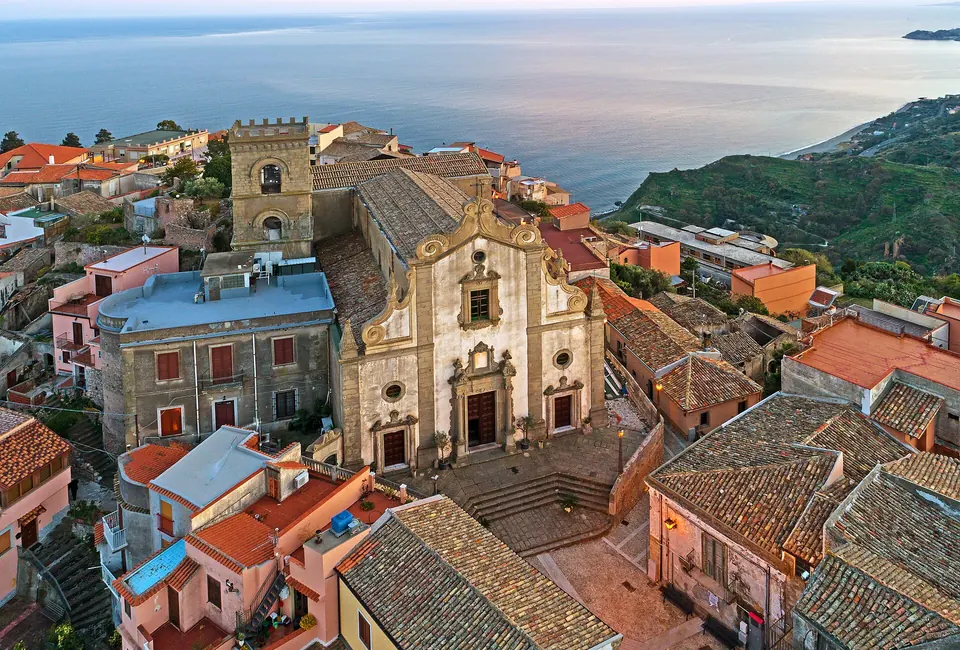
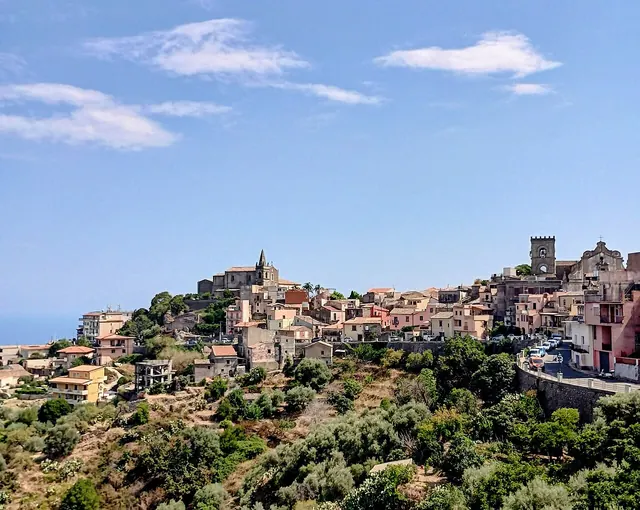
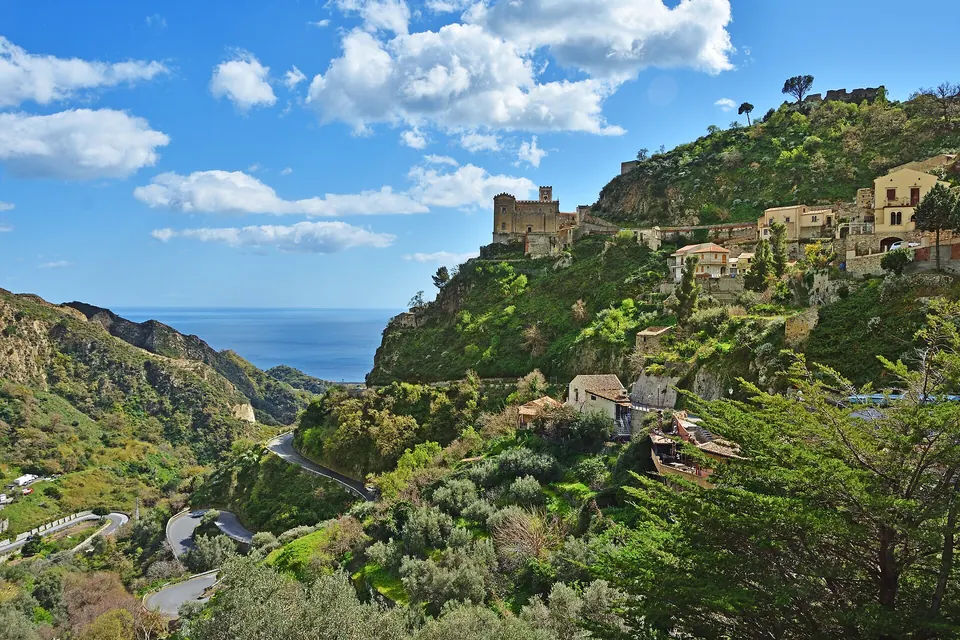
By 1971 the real town looked too modern, and the production was reportedly asked for “protection money”. So Coppola shot “Corleone” in two small villages above the Ionian Sea, Savoca and Forza d’Agrò. The story is set in the island’s west; it was filmed in the east.
Tap a point to see what was filmed there. Most places cluster around Taormina, so zoom in there.
Pick a point on the map, or switch to “Taormina & Etna” to see the villages.
Locations, distances and times are estimates only. Check opening hours, prices, access and safety before you go.
The scenes
In the order they appear
Each card is a scene: what happens, exactly where it was filmed, and what’s there today. “Open in Google Maps” takes you there; “Street View” lets you look around.
I
1972
The Godfather
After killing two men in a New York restaurant, Michael Corleone hides in his father’s Sicily. The mountain villages, his love for Apollonia, the wedding and the bomb make up the chapter in which Michael loses his innocence.
The “Corleone” viewpoint — Madonna del Carmelo chapel — Sant’Alessio Siculo
On screen
Hiding in Sicily after killing Sollozzo and Captain McCluskey in New York, Michael Corleone roams the hills with two shepherd-bodyguards, Fabrizio and Calò, lupara shotguns on their shoulders. On the hilltop ahead sits a village, the film’s “Corleone”. In reality it is Forza d’Agrò, seen from the Sant’Alessio side.
The place today
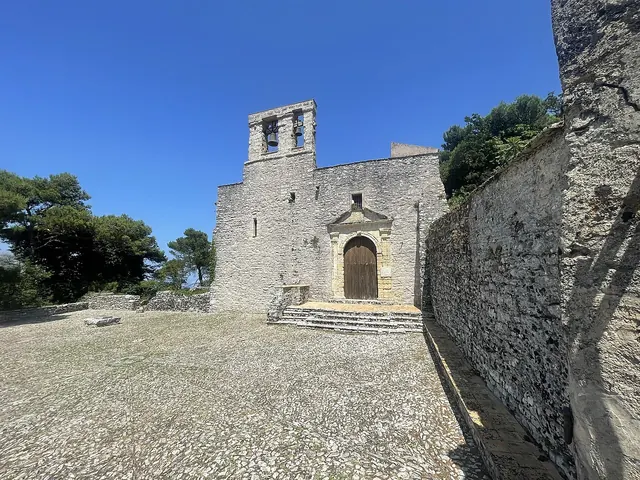
A small chapel on the road up to Forza d’Agrò, less than a kilometre from the village. From here Forza d’Agrò sits on its hill exactly as on screen. Below are the beach town of Sant’Alessio and the castle on the cape.
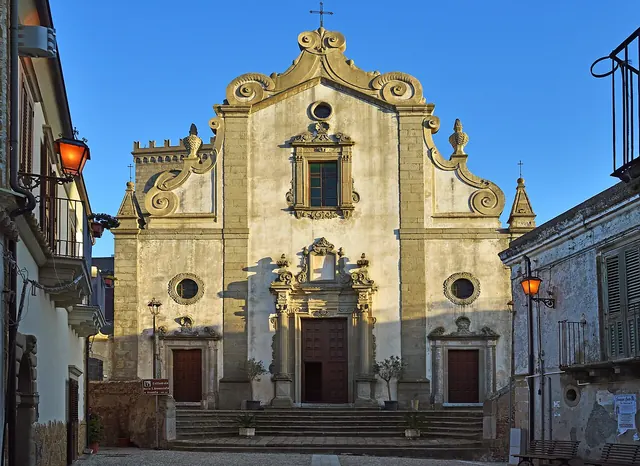
The three walk into the village. The streets are almost empty, and Michael asks where all the men have gone. The answer: dead, every one, in vendettas. They pass the main church of Forza d’Agrò, Corleone’s church on screen, which returns in both sequels.
The place today
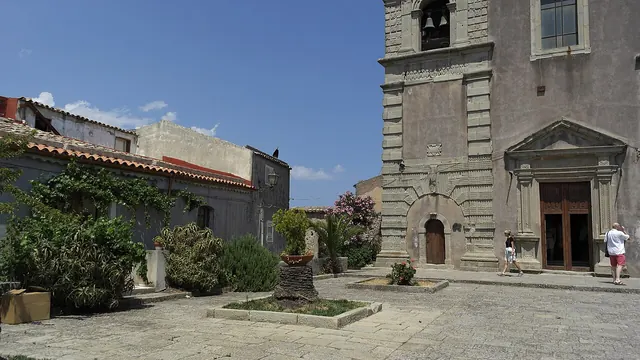
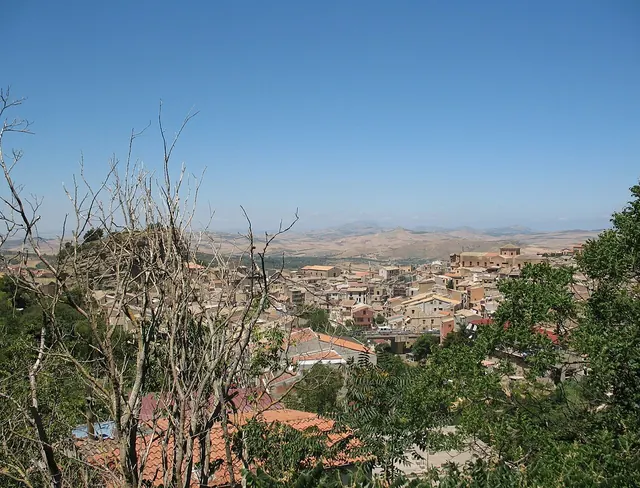
The village’s main church, a Baroque façade at the top of a stairway. The present building dates from 1707, after its predecessor collapsed in an earthquake. Forza d’Agrò is a medieval village 420 m up, with cobbled, mostly car-free lanes, a 15th-century gate (Arco Durazzesco) and the ruins of a Norman castle at the top.
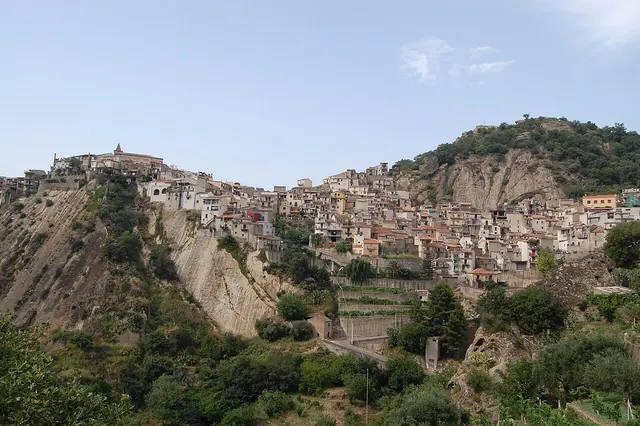
Michael wanders the villages and paths with his bodyguards, learning the land his family came from. According to Italy’s official film-location portal and Italian travel sites, some of these walks were shot in the lanes of Motta Camastra.
The place today
A village hanging off a cliff above the Alcantara valley. A few minutes away is the Gole dell’Alcantara, a spectacular basalt canyon where you can wade in the icy river. It makes for a perfect Godfather-and-nature day.
The “thunderbolt” field — Between Savoca and Forza d’Agrò (approx.) (approximate location)
On screen
In a field in the hills, Michael sees a group of village girls, Apollonia among them. He freezes, and his bodyguards laugh: he has been hit by the thunderbolt, il colpo di fulmine, love at first sight. Fabrizio warns him, grinning, that in Sicily women are more dangerous than shotguns.
The place today
We found no reliable source that pins down the exact field. The Sicilian chapter was shot in the hills around these two villages, and fans say a bridge shows in the background. Whoever finds it solves the trilogy’s great location riddle. The link points to the approximate area.
The three stop at a village bar and Michael asks the owner about the beautiful girl. The owner realises she is his daughter, and the air turns electric. Michael stays perfectly calm. Through his bodyguards, who interpret for him, he asks to meet her properly, at home and in front of the family. So begins the courtship of Apollonia Vitelli.
The place today
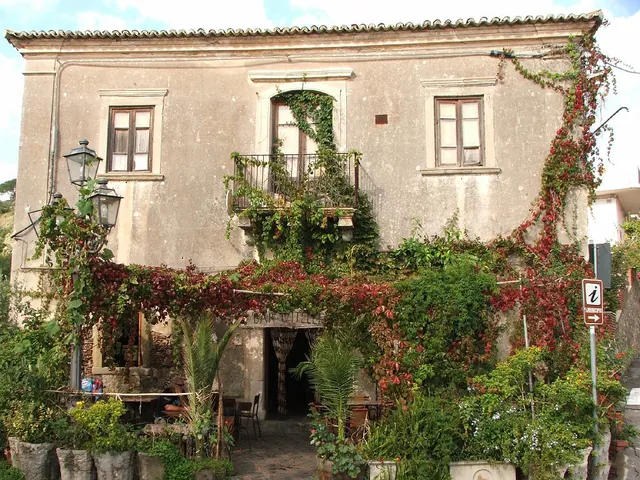
Still open on the ground floor of the 18th-century Palazzo Trimarchi, on Piazza Fossia at the entrance to the village. Sit outside under the ivy; inside, the walls are covered in photos from the shoot. Order the lemon granita. Savoca’s centre is mostly car-free, so park at the entrance and walk.
Did you know? According to Enjoy Sicilia, Palazzo Trimarchi, whose ground floor houses the bar, also served as the Vitelli family home in the film.
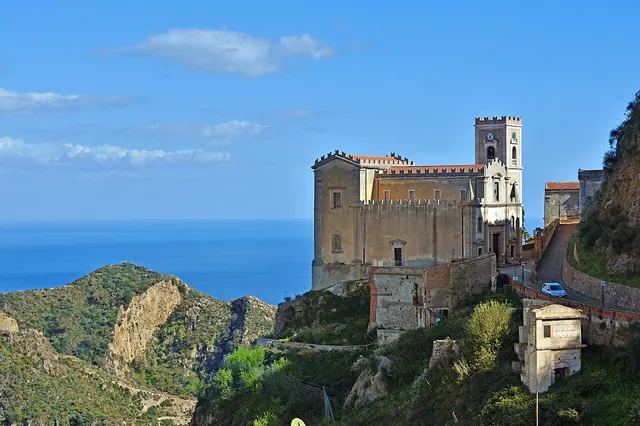
Michael and Apollonia marry in the village church. Then comes the procession: the couple, the family, the musicians and the whole village walk down the narrow street along the cliff, with the Ionian Sea spread out below. It is one of the trilogy’s loveliest, most innocent moments, just before the storm.
The place today
A 13th-century fortress-church on a spur of rock at the end of the village. It houses the silver statue of Santa Lucia, Savoca’s patron saint, which is why many call it “the Santa Lucia church”. The climb is steep; the view over the Ionian Sea repays every step. Nearby, the Capuchin church has a crypt with 17 mummified bodies. Not for the faint-hearted.
Did you know? According to Italian Wikipedia, the famous scenes were shot outside the church.
Castello degli Schiavi (“Castle of the Slaves”) — Fiumefreddo di Sicilia
Private property — view from outside Some buildings here are private and people live in them. Look only from public space, and go in only with permission or during visiting hours, if there are any.
On screen
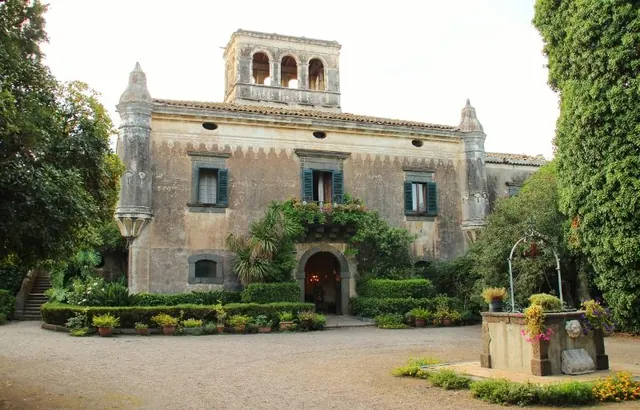
Michael and his young wife live at Don Tommasino’s villa, where he teaches her to drive in circles around the courtyard well. Then the news arrives: his brother Sonny has been murdered in New York, and Michael is no longer safe either. Next morning Apollonia slips behind the wheel to surprise him while Fabrizio, the traitor, quietly vanishes. Michael shouts for her to stop, but the blast comes first.
The place today
An 18th-century Baroque villa among the citrus groves near the sea. Over the lava-stone gate is a Saracen’s head; on the roof, a loggia with two statues of “Turks”, the source of the villa’s name. Italian Wikipedia says that legend was invented for a 1922 newspaper interview. Privately owned; visits by appointment only. In 2022 it also appeared in season two of The White Lotus.
Did you know? According to Balarm, the explosion was filmed at the villa’s entrance and Fabrizio’s escape at the back of the house.
Where the legend begins: in 1901 nine-year-old Vito Andolini loses his family and flees to America. Twenty years later he comes back to settle the score.
The Petrolo stream bed — Graniti, Alcantara valley
On screen
Corleone, 1901. Antonio Andolini, father of nine-year-old Vito, has been murdered for insulting the local Mafia chief, Don Ciccio. The funeral procession winds along a rocky stream bed. Shots ring out, and Paolo, the elder brother who swore revenge, falls dead.
The place today
A rocky stream bed below the village of Graniti in the Alcantara valley. There are no signs and no tourists, just quiet countryside where you can picture the 1901 funeral procession winding between the boulders.
Vito’s mother brings him to Don Ciccio’s villa and kneels to beg for the life of her small, silent boy, who could never harm anyone. When the Don refuses, she puts a knife to his throat and screams at her son to run. The guards shoot her, and Vito escapes through the olive trees.
The place today
An abandoned villa on private land in the Acireale countryside, listed on Google Maps as “Don Ciccio’s Villa from the Godfather II movie”. According to the Sicilian paper Balarm, the Don’s chair still stands where it was. Hard to reach; look from outside only.
That night the Don’s men comb Corleone’s lanes, warning that whoever hides the boy will pay. Villagers tuck Vito into a basket slung on a donkey, with firewood on the other side, and smuggle him out. He sails to America alone. At Ellis Island a clerk writes down his village as his surname, and “Vito Corleone” is born.
According to Italy for Movies and Italian travel sites, the lanes of Motta Camastra also appear in Part II’s flashbacks, as young Vito hides from the Don’s men. Father and son walk the same lanes in two different films, decades apart in the story.
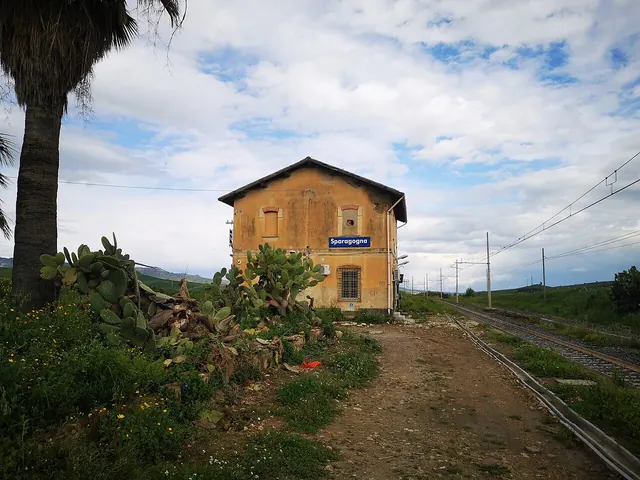
Sparagogna station (“Corleone station”) — Between Agira and Regalbuto (Enna)
On screen
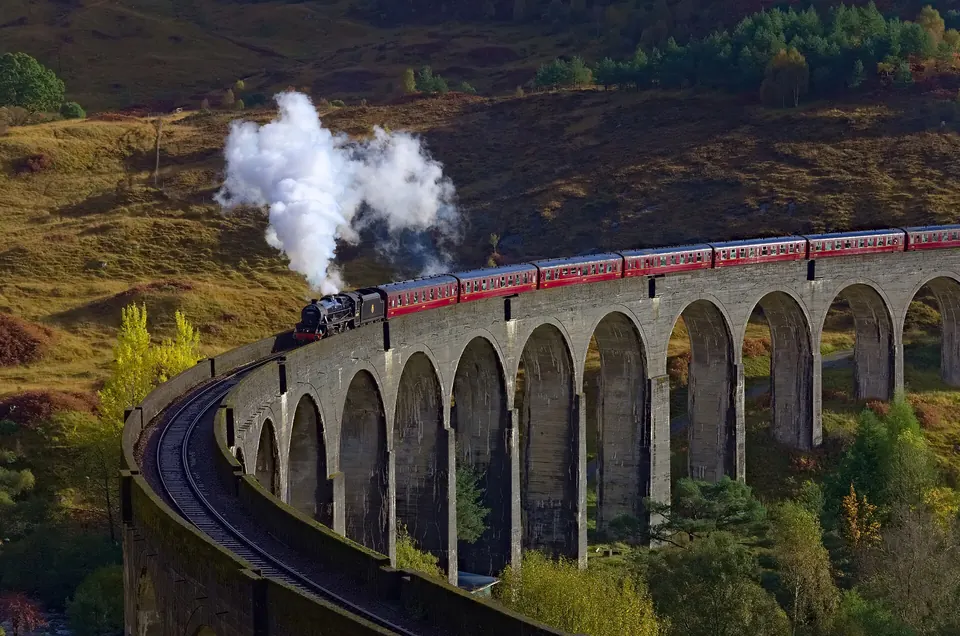
The 1920s. Vito, now a prosperous New York businessman, rides a steam train back to Corleone with his wife Carmela and their children, little Michael among them. In Corleone, Don Tommasino, Vito’s Sicilian partner, is waiting for them. Both the arrival and, later, the departure were filmed on this platform.
The place today
An abandoned country station in the heart of the island, between Catania and Enna, beside the Palermo–Catania motorway (A19). The yellow building still carries its name. Italian State Railways lent a genuine vintage steam locomotive for the shoot.
Did you know? Italian State Railways lent a real Gr 740 steam locomotive for the shoot.
Castello degli Schiavi (“Castle of the Slaves”) — Fiumefreddo di Sicilia
Private property — view from outside Some buildings here are private and people live in them. Look only from public space, and go in only with permission or during visiting hours, if there are any.
On screen
During the visit the family stays with Don Tommasino, at the villa we already know from the first film. In story time, this is the past: decades later the grown-up Michael will hide here, and Apollonia will die in this courtyard. It is one of the few places to appear in all three films.
Vito and Tommasino call on the now ancient, nearly deaf Don Ciccio, claiming they want his blessing for their olive-oil business. Vito leans close, tells him his father’s name, Antonio Andolini, and stabs him to death. As they flee, Tommasino is shot in the legs; when the family leaves Corleone station, he waves goodbye from a wheelchair.
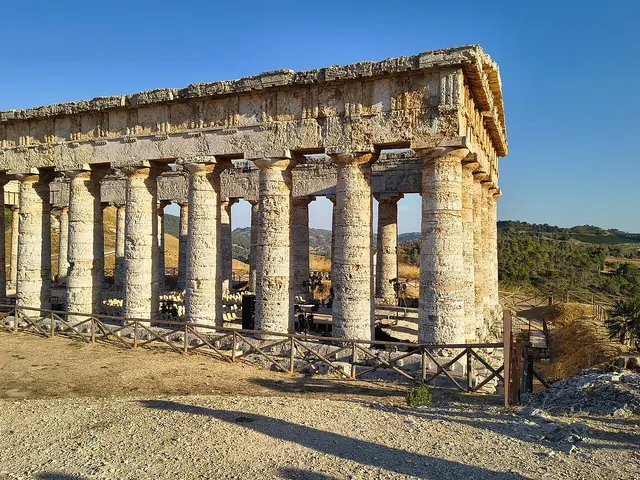
The Corleones arrive in Sicily for the opera debut of Michael’s son, Anthony, in Palermo. Their convoy crosses the golden countryside towards the family villa in Bagheria, with the Greek temple of Segesta rising above the road. In reality this is the SP57 near Calatafimi, at the island’s western end.
The place today
A 5th-century BC Doric temple, one of the best preserved anywhere, with a Greek theatre on the hill above. The archaeological park is open to visitors for a fee. In the film the family’s convoy drives the road below while the temple towers behind it.
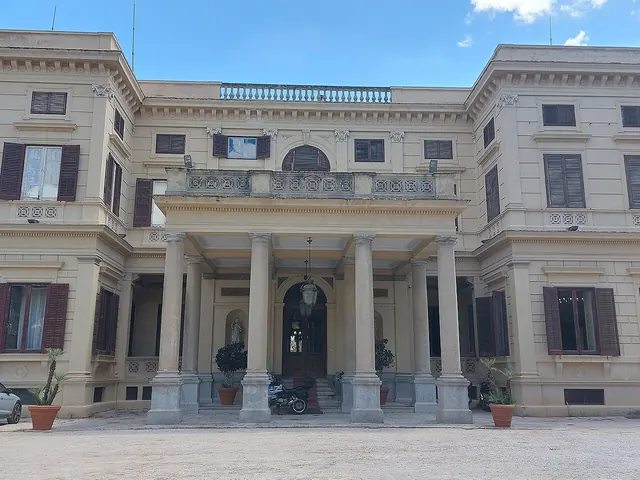
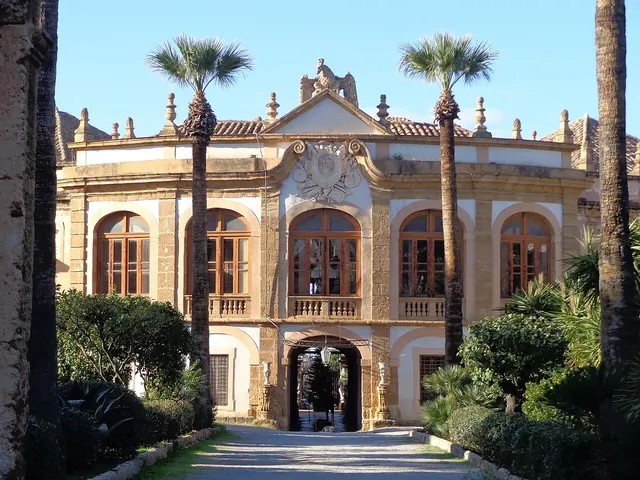
In the story the family’s Sicilian villa is in Bagheria; in reality it is Villa Malfitano in Palermo. Here the family gathers, and here they raise a toast to Anthony’s debut. Both interiors and exteriors were filmed on site.
The place today
Built in 1886 for Joseph Whitaker, of the British Marsala-wine family. It is surrounded by a superb botanical garden with a rare Dragon’s Blood tree. The gardens and villa are open to visitors, usually for a fee; check hours before you go.
On Michael’s orders his hot-headed nephew Vincent calls on Don Altobello and pretends he wants to switch sides. Altobello takes the bait and introduces him to the politician Licio Lucchesi, and Vincent learns that someone in Sicily has been hired to kill Michael.
The place today
A private villa above the Acireale coast, now an events and wedding venue, with a big second-floor terrace facing the sea. Entry only as a guest at an event.
Don Tommasino brings Michael to Cardinal Lamberto, an honest churchman. In the convent courtyard the cardinal lifts a stone from the water and cracks it open: centuries in the water, yet dry inside. So it is with men in Europe, he says, surrounded by Christianity for centuries without it ever reaching them. Weak from diabetes, Michael makes his first confession in thirty years and admits he had his brother Fredo killed.
The place today
A 15th-century church in Erice, a stone town on a mountaintop some 750 m above Trapani, reached by cable car from below. The views take in the bay and the Egadi Islands, and the town is famous for its almond pastries.
Did you know? The convent entrance is Sant’Orsola in Erice. The film’s Lamberto is modelled on Pope John Paul I, who died in 1978 after 33 days in office.
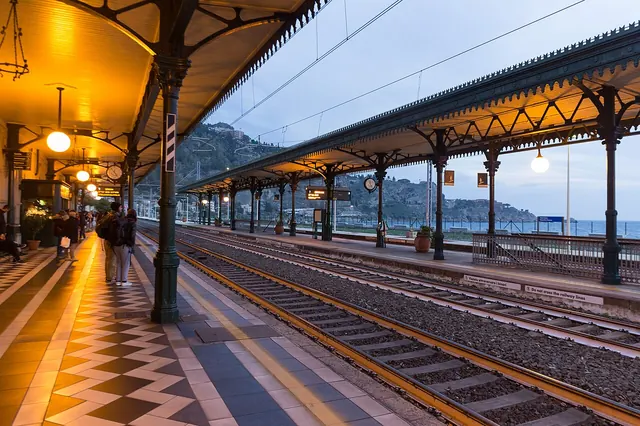
Kay, Michael’s ex-wife, steps off the train at “Bagheria station” to hear their son sing. Michael is waiting on the platform and offers to show her his Sicily. The real station is Taormina-Giardini, on the other side of the island.
The place today
A handsome historic station by the sea below Taormina, still in service, with trains from Catania or Messina. From here you climb up to Taormina, the most convenient base for a Godfather trip.
Private home — please do not disturb People live here. Look only from the public street: don't enter, knock, block entrances or driveways, photograph residents or fly drones. We don't publish the house number, and the links lead to the street only.
On screen
Michael takes Kay to Corleone. The car stops at the corner of Via Belvedere, and he walks her into a narrow lane to show her the house where Vito was born. As the day goes on he opens up to her as never before, and asks her forgiveness.
The place today
The narrow lane where Michael shows Kay the house his father was born in. The location site Almost Ginger places it on Vico I Roma, with the car parked at the corner of Via Belvedere and Via Roma. It’s a private home, so photograph quietly and respectfully.
Mid-tour, a village wedding party pours out of the main church, an echo of Michael and Apollonia’s wedding in the first film. It is the same cathedral Michael walked past in the 1940s, and from whose steps the hunt for little Vito was announced in 1901.
In the main square Michael and Kay join the wedding guests at an “opera dei pupi”, Sicily’s traditional puppet theatre. The puppets play the local legend of the Baroness of Carini, a tale of a father, a daughter and honour that ends in blood. Many see it as a foreshadowing of the film’s ending.
The place today
The square in front of the Holy Trinity church (Sant’Agostino) and its 16th-century Augustinian convent, entered through the Arco Durazzesco gate. On screen it is “Corleone’s” main square.
Mosca of Montelepre, the assassin hired by Altobello, disguises himself and his son as priests. On a country road the old man recognises Mosca under the cassock, but too late. Michael weeps over the body of the man who protected him all his life.
The place today
A country road through the citrus groves at the foot of Etna. Anyone who knows the scene will recognise the Madonna del Carmine church in the shot; use it to find the exact spot.
Opening night. Michael’s car glides slowly along Palermo’s ancient main street towards the Teatro Massimo: the last quiet moment before the trilogy’s great reckoning.
The place today
Palermo’s ancient main street, “il Cassaro” to locals. It runs from the harbour to the cathedral and the Porta Nuova gate, crossing the famous Quattro Canti junction halfway along.
Anthony takes the stage in Mascagni’s opera, set in a Sicilian village on Easter Sunday. While he sings, the revenge unfolds, cut against the music: Connie offers Don Altobello poisoned cannoli in his box, Al Neri kills Archbishop Gilday in the Vatican, and the new Pope dies of poisoned tea.
The place today
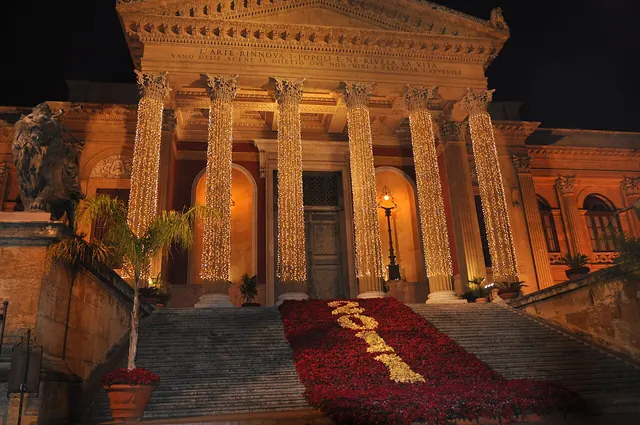
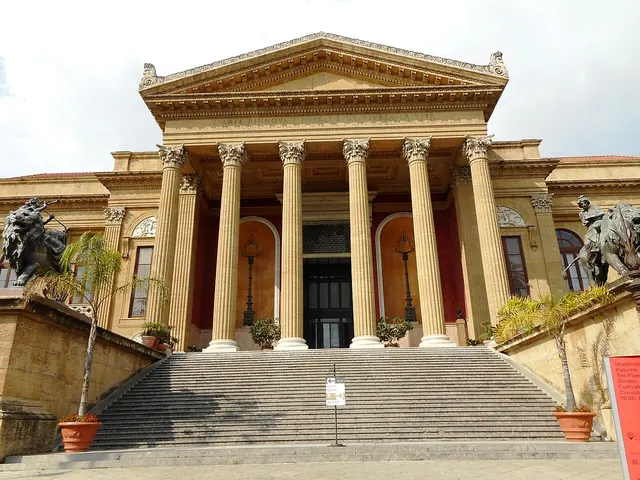
Italy’s largest opera house and Europe’s third largest, opened in 1897. It was closed for a long restoration (1974–1997) during filming, so only the exterior and steps were shot here; the auditorium was recreated at Cinecittà in Rome. Today it offers guided tours and performances.
Did you know? The conductor on screen is Anton Coppola, the director’s uncle. The auditorium scenes were shot at Cinecittà because the theatre was closed for restoration.
That same night Calò, the old bodyguard from the first film, calls at Licio Lucchesi’s palazzo. The story puts it in Rome; it is really a castle in Acireale. Calò leans in and whispers Michael’s message: power wears out those who don’t have it. Then he stabs Lucchesi with his own spectacles, and Lucchesi’s bodyguard shoots Calò dead.
The place today
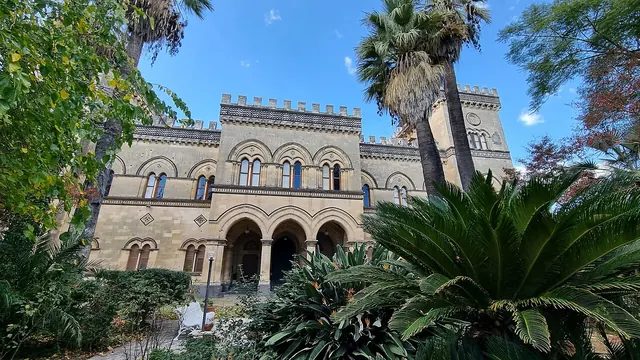
A 19th-century neo-Gothic castle of the Pennisi di Floristella barons, in a private park in Acireale. It was offered for sale in 2020–2022 for some five to six million. Private; seen from the street only.
Did you know? The line is a famous quip by Italian prime minister Giulio Andreotti: “Il potere logora chi non ce l’ha.” Franco Citti played Calò in both 1972 and 1990, eighteen years apart.
The performance ends and the family steps out onto the grand staircase. Mosca opens fire: one bullet hits Michael, the next kills his daughter, Mary. Vincent shoots the assassin. Michael kneels on the steps with Mary in his arms and lets out a long scream that begins in silence. One of cinema’s most harrowing moments, shot on the theatre’s real steps.
Castello degli Schiavi (“Castle of the Slaves”) — Fiumefreddo di Sicilia
Private property — view from outside Some buildings here are private and people live in them. Look only from public space, and go in only with permission or during visiting hours, if there are any.
On screen
Years later, old and alone, Michael sits on a chair in the courtyard of Don Tommasino’s villa, the same courtyard as in the first film. He remembers dancing with the three women he loved, Mary, Apollonia and Kay, then slumps from the chair and dies, a dog wandering past. The trilogy ends where his Sicilian tragedy began.
Did you know? In Coppola’s 2020 recut, “The Godfather, Coda: The Death of Michael Corleone”, he dropped the fall from the chair and ended instead on a title card about the Sicilian blessing “cent’anni”.
In the story, Vito Andolini was born here, and the town gave him his name, yet it barely appears on screen. By 1971 it looked too modern for the 1940s, and the production was reportedly asked for “protection money”. So “Corleone” was shot in Savoca and Forza d’Agrò, some 180 km to the east.
The place today
About an hour’s drive south of Palermo. Visit CIDMA, the international documentation centre on the Mafia and the anti-Mafia movement, which displays files from the Maxi Trial against Cosa Nostra. A sobering visit that shows the real story behind the films.
In Part III, Michael’s villa is in Bagheria, just east of Palermo, and Kay’s station bears its name. According to the sources, the “Bagheria” scenes were all shot elsewhere: in Palermo, Taormina and Segesta.
The place today
The real Bagheria is famous for its 18th-century aristocratic villas, above all Villa Palagonia, the “Villa of Monsters”, whose walls are lined with dozens of grotesque statues. Open to visitors.
Savoca and Forza d’Agrò are about 20 minutes apart and half an hour from Taormina. Inside the villages you go on foot. Start with a granita at Bar Vitelli and end with sunset at the viewpoint.
Start in the gardens of Villa Malfitano, move on to the Teatro Massimo steps (guided tours available), walk the old main street, and finish with a 20-minute drive to Bagheria’s Villa of Monsters.
By 1971 Corleone looked too modern, and the production was reportedly asked for “protection money”. So the family’s village was shot in Savoca and Forza d’Agrò, some 180 km east.
🍊
Oranges mean danger
Throughout the trilogy, oranges keep turning up just before a death or an attempt on someone’s life. Watch for them next time.
⛈️
50 days for 11
On Part II the crew was stuck in Sicily for more than 50 days by bad weather, and managed only 11 days of shooting.
🐟
Ellis Island in Trieste
Part II’s Ellis Island scenes were filmed in Trieste’s old fish market, today the Salone degli Incanti exhibition hall.
🎭
23 years in the dark
The Teatro Massimo was closed for restoration from 1974 to 1997, so only its exterior and steps were filmed; the auditorium scenes were shot at Cinecittà in Rome.
🎼
A conductor in the family
The Cavalleria Rusticana on screen is conducted by Anton Coppola, Francis Ford Coppola’s uncle.
👓
Calò returns
Franco Citti played Calò, Michael’s bodyguard, in 1972 and again in 1990, coming back after 18 years for one unforgettable scene.
🏰
Three films and a TV series
Castello degli Schiavi appears in all three films, and in 2022 in season two of The White Lotus.
💍
Apollonia was 16
Simonetta Stefanelli, who played Apollonia, was 16 during filming.
🚂
A real steam engine
For Part II’s station scenes, Italian State Railways lent a real Gr 740 steam locomotive.
🎨
A painter found the places
The Sicilian locations were chosen by the painter Gianni Pennisi di Floristella. His family name also belongs to the Acireale castle where Lucchesi dies.
0of 23 places
My passport
How many have you visited?
Tourist
Tap “I’ve been here” at every place you visit. Your passport is saved in your browser, and you can share it with friends.
Before you go
Tips for the road
🧭
Base
Taormina for the east, where most places are, and Palermo for the west; they are about 3 hours apart by car. Catania airport is the closest to the Godfather villages, about an hour away.
🚗
Car
Rent a car. In Savoca and Forza d’Agrò, park at the village entrance; the lanes are narrow and mostly car-free.
⛪
Churches
Cover shoulders and knees in churches, and keep quiet during services.
🏠
Private property
Some places are private homes or closed villas. Photograph from the street; don’t enter courtyards.
🕐
Hours
Opening hours and prices change. Check the place’s Google Maps card, linked here, before you set out.
🌅
Season
Spring and autumn are loveliest. Summer middays are very hot, so start early and finish at sunset.
FAQ
Questions and answers
Where was The Godfather filmed in Sicily?
Most of the Sicilian scenes were filmed in the east of the island, around Taormina: in the villages of Savoca and Forza d’Agrò, which stood in for “Corleone”, at Castello degli Schiavi in Fiumefreddo, and in Acireale. In the west, the films used Palermo (the Teatro Massimo and Villa Malfitano), Segesta and Erice. This guide covers 30 scenes at 23 places, each linked to Google Maps.
Hardly. By 1971 the real town looked too modern for the 1940s, and the production was reportedly asked for “protection money”. So the films’ “Corleone” was shot in Savoca and Forza d’Agrò, some 180 km to the east. The real Corleone is about an hour’s drive south of Palermo.
Yes. It still operates on the ground floor of Palazzo Trimarchi, on Piazza Fossia at the entrance to Savoca. Inside, the walls are covered in photos from the shoot; order the lemon granita. The village centre is mostly car-free, so park at the entrance and walk.
In Savoca. The ceremony takes place at the church of San Nicolò, which many call “the Santa Lucia church”, and the procession then walks down the narrow street along the cliff. According to Italian Wikipedia, the famous scenes were shot outside the church.
Where was Apollonia’s car bomb scene filmed, and can you visit?
At Castello degli Schiavi in Fiumefreddo di Sicilia, an 18th-century Baroque villa that plays Don Tommasino’s villa. It appears in all three films, and the trilogy ends there. The villa is privately owned, and visits are by appointment only.
Where was the opera steps scene at the end of Part III filmed?
On the real steps of the Teatro Massimo in Palermo, Italy’s largest opera house. The theatre was closed for a long restoration (1974–1997), so only the exterior and the steps were filmed there; the auditorium scenes were shot at Cinecittà in Rome. Today it offers guided tours and performances.
What’s the best way to visit the filming locations?
Rent a car. Taormina is the handiest base for the east, where most of the places are, and Palermo for the west; they are about 3 hours apart by car, and Catania airport is about an hour from the Godfather villages. This guide has 6 ready-made routes, each opening in Google Maps with one tap.
It is the trilogy’s great location riddle. We found no reliable source that pins down the exact field. The Sicilian chapter was shot in the hills around Savoca and Forza d’Agrò, and fans say a bridge shows in the background.